Select your language from the drop down menu.


.jpg "From the Alps to Burnside: The Remarkable Journey of Klaus Mayer")
Published: 5 March 2026
It started with a letter.
When a Swiss researcher contacted the City of Burnside looking for information about a man named Klaus Mayer, Historical and Cultural Officer Hannah wasn’t expecting the trail to lead where it did. The researcher had been commissioned by the Swiss Government to document the lives of refugees who fled Europe through the Austrian–Swiss border during the Second World War. In his records, he had found a Klaus Mayer who died in 1991 in Beaumont. He wanted to know - was this the same man?
‘The researcher had identified the City of Burnside through the death records of a man in Beaumont with the same name as a former German citizen,’ Hannah says.
What followed felt less like routine council work and more like detective work. Hannah traced name records, newspaper articles and details of his Order of Australia Medal. Bit by bit, the story came together.
‘These were all the pieces of the puzzle that came together to confirm this was the right Klaus Mayer.’
Finding family proved harder. After exhausting official records, she turned to Google. A Rotary Club article mentioning a Peter Mayer - whose father Klaus had escaped Europe during the war provided the missing link. The details aligned. From there, Hannah connected the Swiss researcher with Rotary, and eventually with Peter himself.
‘This was a little different from our usual requests – it felt like being a detective,’ Hannah says.
‘It took more effort than the usual request, but it was so rewarding.’
For Peter, a long-time Burnside resident, the contact from Switzerland reopened a remarkable family story, one that began with his father Klaus in Germany in 1915.
Klaus Mayer was born in 1915 in Mannheim to a prominent family, the child of Erich and Luise Mayer. His father was President of the Cigar Manufacturers Association and a founding member of the Mannheim Rotary Club in 1930. It was a privileged childhood that would stand in stark contrast to what followed.
As Europe shifted under the rise of the Nazi regime, definitions of identity evolved. Klaus and his parents were Lutheran, but because of their Jewish background they were eventually classified as enemies of the state. Like all young men of his generation, Klaus completed his civil duties and was later conscripted when war broke out, but even this service to the country could not protect him.
‘While he was in the army, they couldn’t touch him, but then those rules changed as well,’ Peter Mayer says.
A commanding officer, aware that an impending interview would likely end badly, quietly warned Klaus and issued him a backdated leave pass. It was an opportunity to disappear.
However, before Klaus could help his parents escape, they too received arrest papers. Faced with transportation, they chose to take their own lives rather than face the horrors they knew awaited.
In the spring of 1942, Klaus booked himself on what appeared to be a holiday in Gargellen, a village near the Austrian-Swiss border. A trained mountaineer with a guide certificate in the region, he knew the terrain intimately. He also knew he couldn’t look like he was planning to climb - that would draw suspicion - so he travelled in ordinary clothes.
His first attempt to cross the Alps failed. Leaving under the cover of heavy cloud and darkness to avoid moonlight, he climbed in the pitch-black to what he believed was the correct ridge and descended the other side, only to discover, by the brief flare of a match, a sign warning he was approaching the German border. He had walked in a fold of the ridge and circled back.
He barely made it to his hotel before dawn, sneaking in through a window as other guests stirred.
Two stress-filled days later, he tried again.
The route between Gargellen and Klosters later became known as the “Smugglers’ Route”. Many who attempted it were shot. Others paid smugglers to guide them. Klaus crossed alone.
‘I’ve been to Gargellen and I’ve seen the mountain he climbed,’ Peter says. ‘It was pretty daunting.’
In the history of those who crossed this route into Switzerland during the war, Klaus Mayer is the only one to successfully make the crossing safely by themselves without the assistance of smugglers.
Klaus’ journey runs the gauntlet of near misses, remarkable acts of courage, and stories of others risking their own safety to help him escape certain death. It was a life layered with far more depth and intrigue than any single telling could fully capture.
Once in Switzerland, safety was not immediate. Anyone caught near the border risked being handed back. Klaus made his way to Zurich, where he could formally apply for asylum, but he was arrested as an absconder from the German Army and not seen as a political refugee. After six months in jail followed by time in a labour camp, he was eventually granted refugee status.
It was in Switzerland that he met his wife, herself a refugee who had fled political persecution before the war. Together, after briefly returning to Germany post-war, they worked with a refugee aid organisation, establishing orphanages and running food programs in Hamburg.
But they wanted distance, a fresh start far from the upheaval of Europe. Australia, South Africa and South America were considered. In 1950, they chose Australia. Klaus had his heart set on Adelaide, a city, but without the hustle and bustle of Melbourne and Sydney and with a country community feeling.
When their ship docked in Fremantle, the first impressions were not promising. It was 40 degrees, flies everywhere, and a skyline of galvanised iron woolsheds. Peter recounted how his mother thought they had ‘hit hell on earth’.
Klaus worked as a farm hand near Tumby Bay, embracing rural life as a way to immerse himself in Australian culture. Eventually the family settled in suburban Adelaide. Peter grew up in Beaumont, later buying his first home in Kensington Gardens, spending 30 years in Rostrevor before returning to Burnside more than two decades ago.
Klaus was naturalised as Australian in 1955. He did not seek dual citizenship.
For years, Klaus barely spoke about that period. ‘For a long time, my father did not talk about the past,’ Peter says. ‘He was future focused.’
‘As far as I am concerned, I am Australian,’ Peter recalls his father saying.
Peter, who had moved to Australia with his parents when he was only two years old, was also naturalised in 1955 at the same time as his mother and father.
Despite everything, Klaus did not abandon his cultural roots. He became Vice-President of the German Club of Adelaide and later President of the Bridge, a roof organisation for all the German speaking clubs in Australia. He was active in Rotary and later served as President. His contributions to preserving German language and culture in Australia were recognised with the Order of Australia Medal and Germany’s Federal Cross of Merit.
Peter says his father’s experiences shaped his outlook profoundly. During the early days of the Vietnam War, when some young Australians spoke of war with excitement, Klaus drew parallels with the atmosphere he had witnessed in Germany decades earlier. ‘That’s how things were in Germany too,’ Peter recalls him saying, a reminder of how easily collective enthusiasm can tip into something darker.
‘It proves there is no black and white. People behave in different ways depending on who they are with. I’ve always been wary of mob hysteria.’
When the Swiss archives contacted him decades later, Peter was astonished by the detail preserved in official records. ‘When I read all the information – it was just amazing,’ he says. Files revealed employment records and dates he had never known. A retired Lutheran priest near the border where refugees once crossed is now writing their histories - including Klaus’.
Today, Peter’s life is firmly rooted in Burnside. He is a member of the Burnside Bicycle User Group, State Coordinator for Mountain Bike Orienteering, and a familiar face walking his dog through Kensington Wama / Kensington Gardens Reserve. He joined Rotary after his father’s passing, continuing a thread that stretches back to Mannheim in the 1930s.
At 16, Peter returned to Switzerland for the first time, staying with friends who had once helped his father. Arriving at an alpine resort on a crystal-clear night with a full moon reflecting off snow-covered peaks, he felt ‘like I had died and gone to heaven.’ The experience sparked a lifelong love of skiing that continues to take him to Japan, Canada and Europe whenever he has the opportunity.
Klaus’ story began in upheaval, crossed mountains in darkness, and ended in quiet community service in suburban Adelaide. Through Hannah’s detective work and a letter from Switzerland, that journey has come full circle - from the Alps to Burnside.
The City of Burnside’s Historical and Cultural Officers are available to assist any person with an enquiry. To submit an enquiry via our website visit our website(External link) or stop by the Local History Room every Monday between 1.30 pm and 4.30 pm.
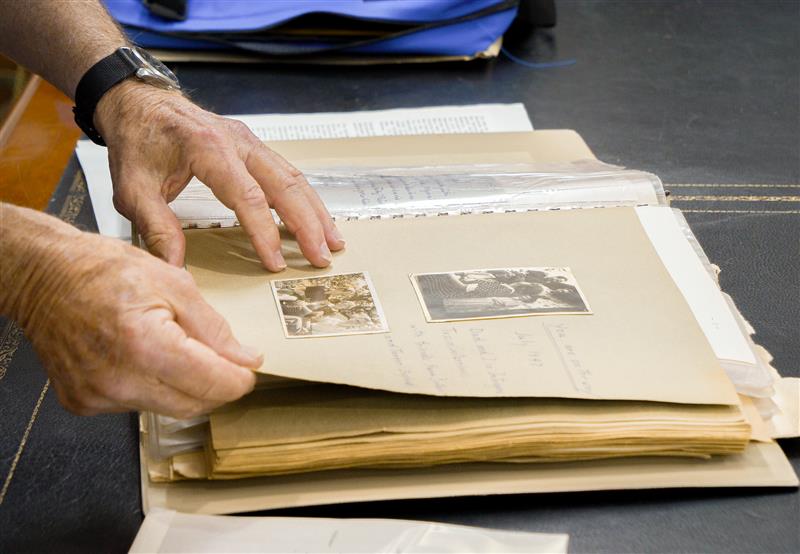
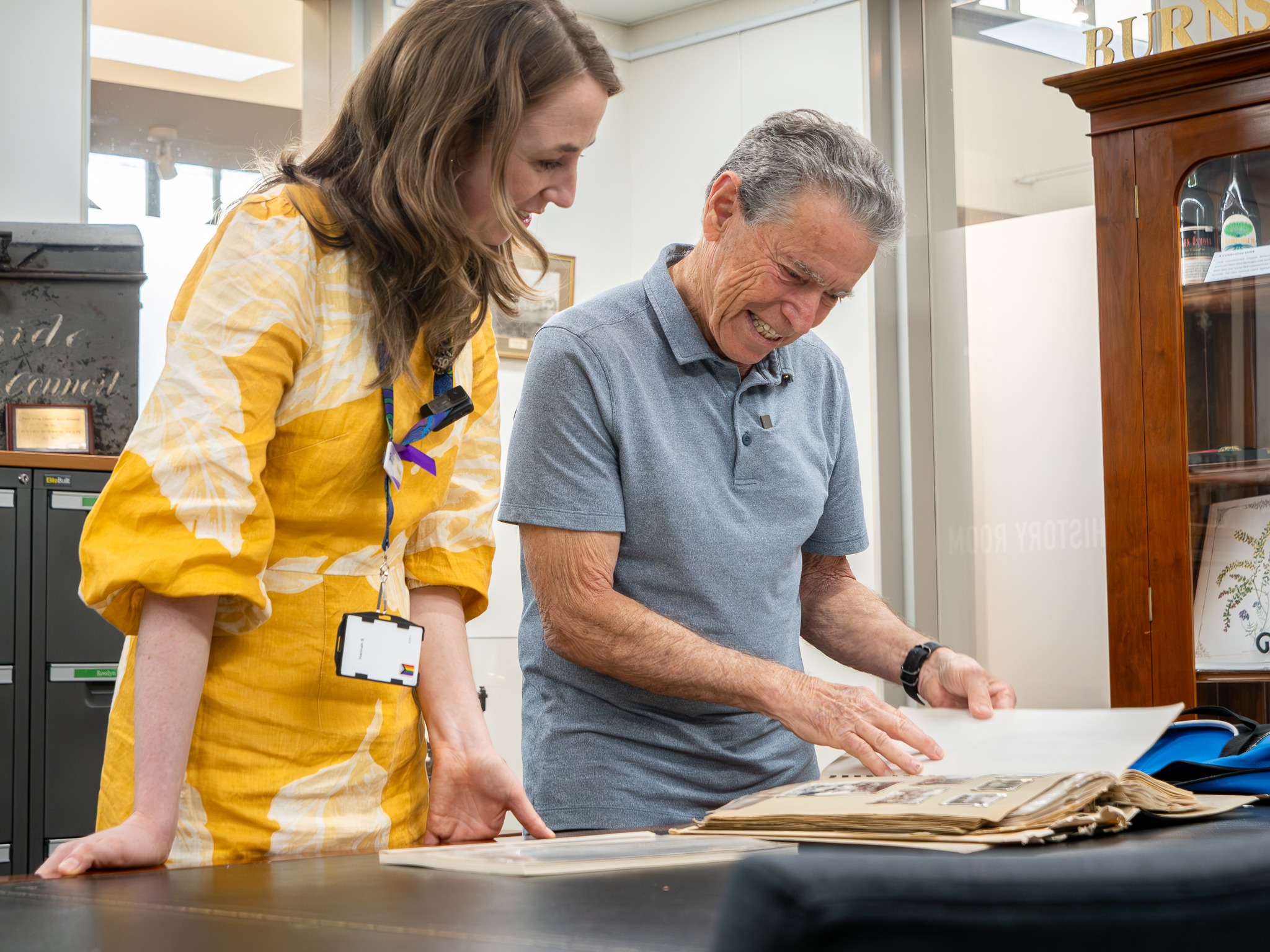 Peter and Hannah look over some of his parents documents and photos
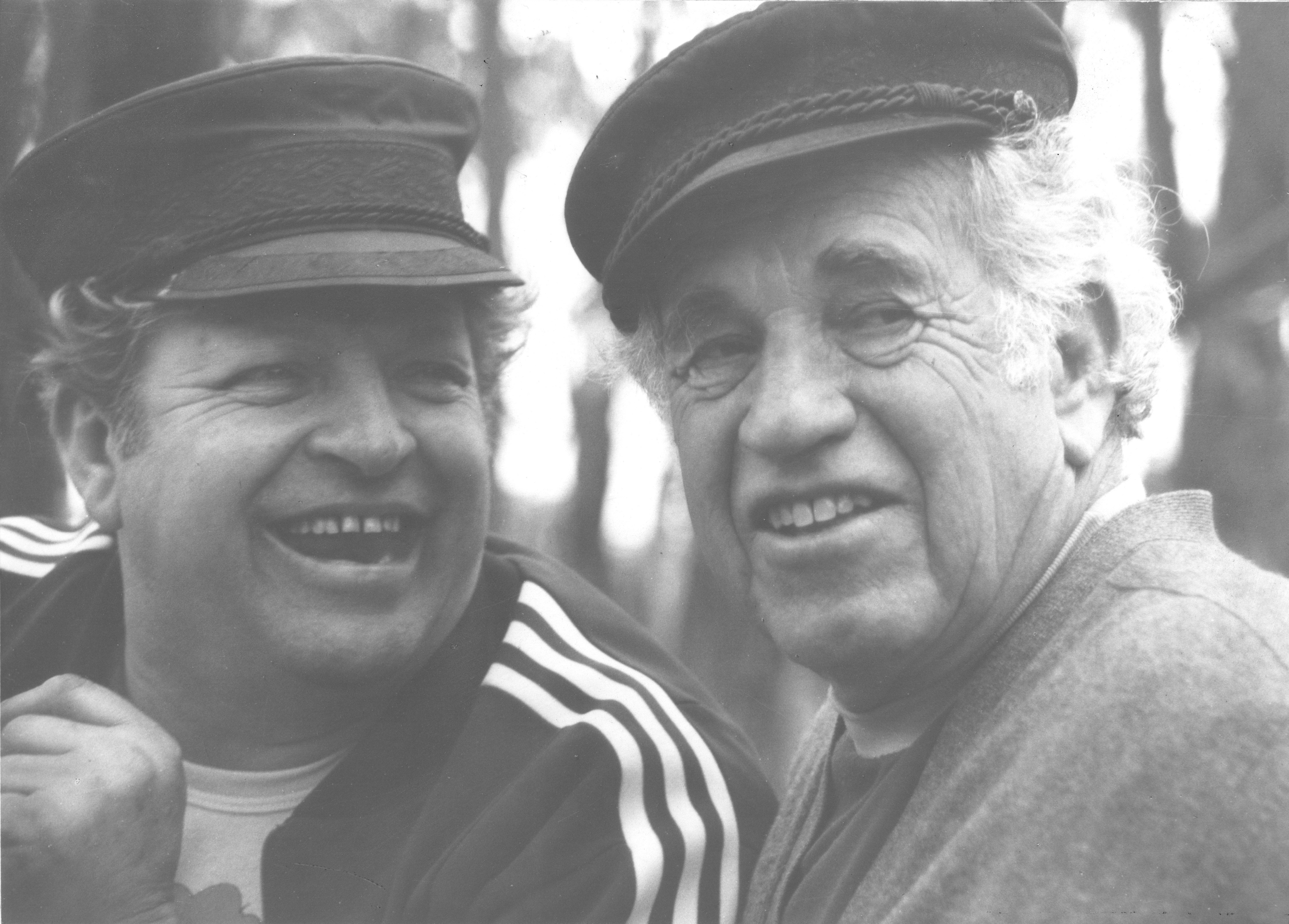 Klaus Mayer (right)



We've launched a fresh new home for engage.burnside. To continue receiving updates and taking part in our engagements, please register here, even if you had an account with us before.
Once registered, you can receive updates straight to your inbox, and be among the first to have your say on upcoming projects.